

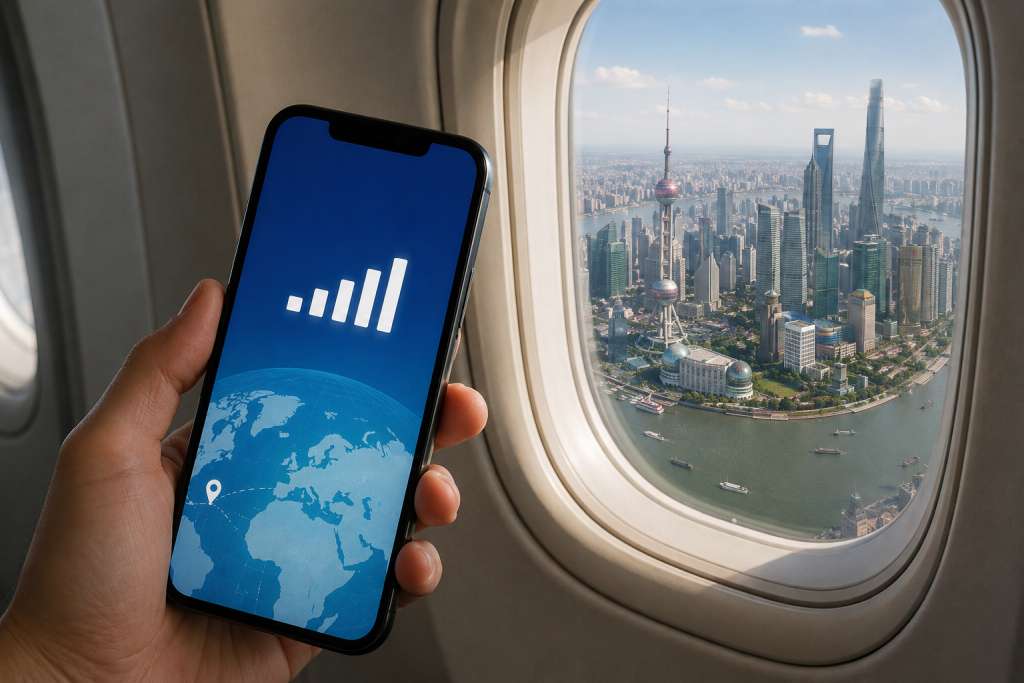
You land at Pudong at 11pm, you need a map, a ride-hailing app, and a message home saying you made it — and this is exactly the moment an eSIM for China earns its keep. Here’s the complete, current picture: how it works, what it actually gets you, the one mistake that catches almost everyone, and how it fits alongside getting a proper local number once you’re settled.
What an eSIM actually is, in plain terms
An eSIM is a digital SIM card — no plastic chip, no SIM tray, just a QR code you scan that installs a mobile data profile onto your phone. For China specifically, international travel eSIMs (Airalo, Holafly, Nomad, Saily, Jetpac, Simbye and others) work by routing your data through gateways outside mainland China, rather than through a domestic Chinese carrier.
That routing detail is the whole reason expats and travellers use them: it means the apps, sites and services you’re used to back home — the ones that are typically hard or impossible to reach on a local Chinese SIM or hotel WiFi — work normally on your phone from the moment you land, no separate setup, no extra app, no fiddling. Maps, messaging apps, email, social media, video calls home — it just works the way it does everywhere else. That’s arguably the single biggest reason a travel eSIM beats grabbing a local SIM at the airport on day one.
The mistake that catches almost everyone: activate before you land
This is the rule the whole system hinges on, and it’s non-negotiable: you must install and activate your China eSIM before you enter mainland China. Once you’re physically inside the mainland, phones cannot install a new eSIM profile from a non-mainland carrier — the install step itself is blocked at the network level. Do it from your home country’s WiFi, or at your layover airport, but do it before wheels-down in Shanghai.
A related rule worth tattooing on your hand: once installed, don’t delete the eSIM while you’re in China. If you remove the profile by mistake, you can’t reinstall it until you’ve left the country. If your data seems to be misbehaving, troubleshoot it — don’t delete and reinstall.
The trap that catches long-term expats specifically
Here’s the detail most travel-focused eSIM articles never mention, and it matters far more to you than to a two-week tourist: iPhones purchased in Mainland China, Hong Kong, or Macau have eSIM functionality disabled at the hardware and carrier level. If you buy or replace your iPhone locally in Shanghai, it will not accept an international travel eSIM — full stop, regardless of iOS version. (There’s one narrow 2026 exception — the iPhone Air bought in mainland China supports a China-carrier eSIM only, activated in-store with ID — but that doesn’t help you install a foreign travel eSIM.)
The practical takeaway: if eSIM matters to you, keep the phone you brought with you, or buy your next phone somewhere outside mainland China. Any iPhone from the XS/XR generation onward (2018+) purchased outside Mainland China, Hong Kong or Macau supports eSIM natively. Most recent Android flagships (Pixel, Samsung Galaxy S and newer Fold/Flip models, sold outside China) support it too — check your specific model before you travel, since regional variants genuinely differ.
What an eSIM does not give you
This is the distinction that matters most once you move past the arrival week: a China travel eSIM is data-only. It does not come with a real, bindable Chinese phone number. That means it can’t complete WeChat’s SMS verification, can’t register for most delivery or ride-hailing apps that require a Chinese number, and can’t be used to open a bank account. For that, you’ll eventually want an actual local SIM — we’ve written the full guide to getting a SIM card in Shanghai for exactly that step, and most residents end up running both: a local number for day-to-day China life, an eSIM as backup data or for visiting friends who haven’t made that switch yet.
Think of it this way: eSIM gets you connected today; a local SIM makes you a resident.
What it actually costs and covers (2026 pricing)
Prices move constantly in this market, so treat the following as a snapshot rather than gospel — always check current rates before buying:
- Short trips (under a week): fixed data plans from major providers start around $4–12 USD for a few gigabytes over 7 days — plenty for maps, messaging and social apps.
- A month in the city: expect roughly $12–22 USD for 10–20GB over 30 days, depending on provider — a reasonable range for someone settling in before switching to a local SIM.
- Unlimited-style plans exist (Holafly, Airalo’s newer unlimited tier) but “unlimited” usually means a daily high-speed allowance — often around 3GB/day — before throttling to a slower speed. Read the fine print; not every provider publishes their throttle policy clearly, and that’s worth knowing before you buy.
- Hotspot/tethering rules vary by provider — some allow unlimited tethering, some cap it around 1GB/day. If you’re planning to share your connection with a travel companion or a laptop, check this specifically before purchasing.
Coverage is strong in Shanghai and other major cities (Beijing, Shanghai, Guangzhou, Shenzhen, Xi’an, Chengdu) and along the high-speed rail corridors between them — this covers the overwhelming majority of what a relocating expat actually needs. Coverage thins out in remote rural areas, which matters more for a Silk Road trip than for city life.
A quick decision guide
- Arriving for a work trip or short visit? A data-only eSIM, bought and installed before departure, is genuinely the easiest option available — no queue, no ID paperwork, no shop visit.
- Moving to Shanghai long-term? Use an eSIM for your first days, then get a local SIM within your first week or two — you’ll need the Chinese number for WeChat, delivery apps, and eventually your bank account and lease paperwork. Our SIM card guide and Alipay & WeChat Pay setup guide cover the rest of that first-week checklist.
- Buying a new phone once you’re settled? Buy it outside mainland China if you want to keep eSIM flexibility for future trips — or accept that a mainland-purchased iPhone commits you to physical SIMs going forward.
Tell us what actually worked for you
Providers and plans genuinely change month to month in this space — a network that was rock-solid last spring might throttle harder today, and a brand-new provider might turn out to be excellent. Rather than us pretending to have the final answer, we’d genuinely love to hear from readers in the comments: which eSIM did you use for your Shanghai arrival, did it hold up on the metro and at home, and would you use it again? Real, current experiences from people who’ve actually landed here are worth more than any single roundup — this one included.
Settling into Shanghai and want the rest of the first-week checklist? See our guides to [getting a SIM card], [Alipay and WeChat Pay setup], [police registration], and [home internet] — and when you’re ready for the apartment itself, browse our listings in Old Xuhui, Jing’an and Changning.

Join The Discussion