

If you’re relocating to Shanghai, one of the first questions on your mind is: can my pet come with me?
Short answer: yes. Longer answer: it takes real planning, exact paperwork, and enough lead time — but it’s entirely doable, and more people are doing it successfully every year. Here’s what the process actually involves, based on China’s official customs regulations.
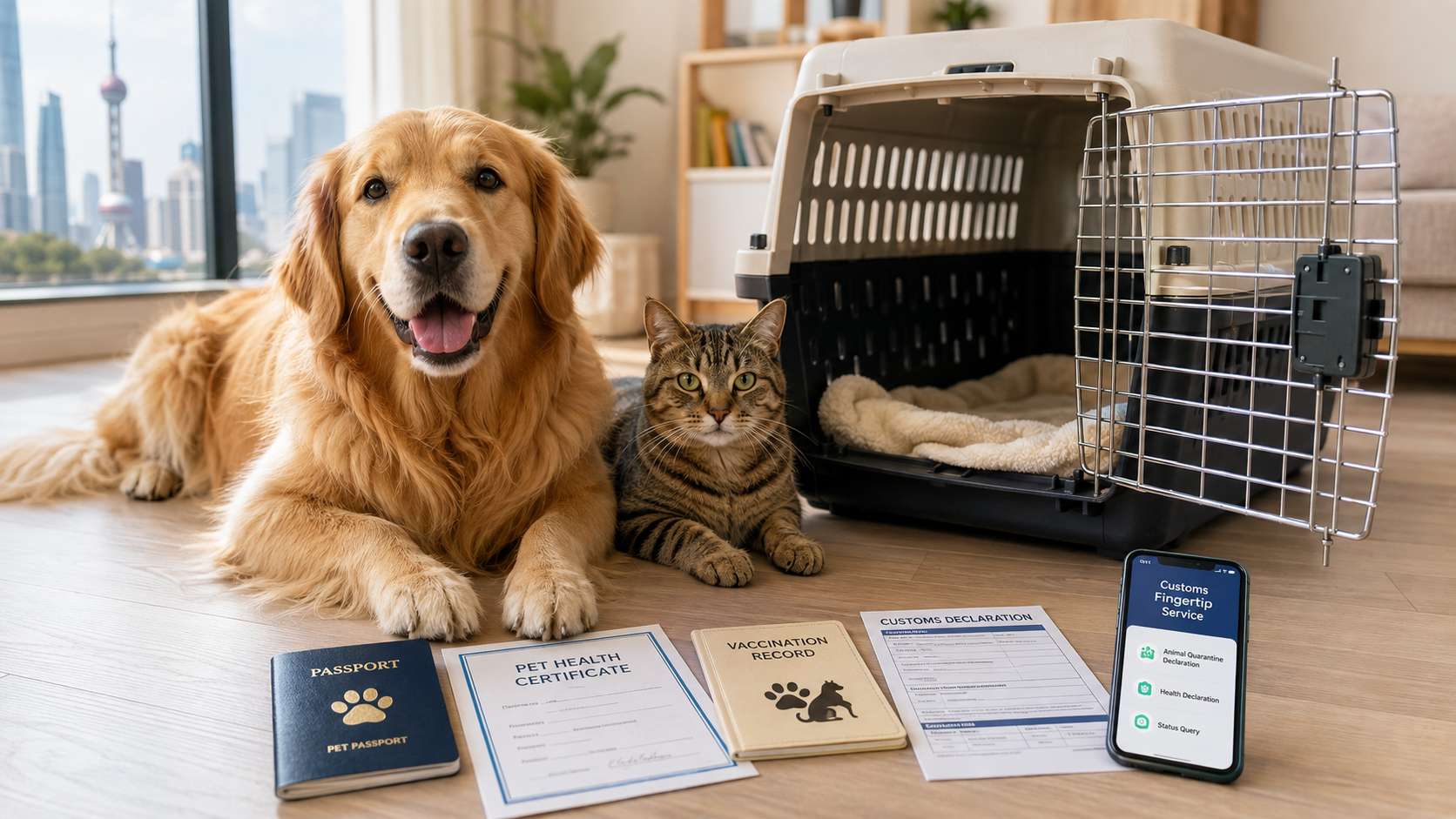
The Good News: Pet Travel to Shanghai Is Booming
More people are bringing pets to Shanghai than ever before. In the first quarter of 2026 alone, Shanghai Pudong International Airport processed 1,890 inbound pets — a 21.5% increase compared to the same period in 2025 .
The Chinese government has also improved the process. Customs authorities now display pet import rules prominently in arrival areas and have launched the “Customs Fingertip Service” (海关指尖服务) mini-program, where you can check requirements and complete procedures online .
This means you are not alone — and the system is becoming easier to navigate.
The One Big Rule: One Pet Per Traveller
Each person entering China may bring only one dog or cat with them. Currently, only dogs and cats are permitted for personal (non-trade) pet import — no other species. If you’re moving with two pets, you’ll need two separate travellers, each with their own complete document set.
The Two Paths: Quarantine-Free or 30 Days
This is the single most important decision point in the whole process — and it comes down almost entirely to preparation.
Path 1: Quarantine-free entry. Your pet can be released the same day it lands if you meet all of the following:
- An ISO 11784/11785-compliant microchip (15 digits, numbers only, and readable by a standard scanner)
- A valid rabies vaccination certificate issued by the official animal quarantine authority in your departure country
- If travelling from a country not on China’s designated exemption list (see below): a rabies antibody titer test (RNATT), blood drawn after vaccination, result ≥0.5 IU/ml, from a laboratory whose results China’s customs authority accepts
- An official animal health certificate, issued after a clinical check within 14 days of arrival, confirming the pet is free of diseases on China’s list of quarantinable conditions (rabies among them)
Path 2: 30-day quarantine. If any requirement is missing — an incompatible chip, an invalid or missing titer result, an expired health certificate — customs can require your pet to spend 30 days at a designated quarantine facility, at your cost. Pet relocation agencies typically quote a rough range in the low thousands of RMB for this, though costs vary by facility and animal size — get a specific quote if you’re anywhere near this scenario, don’t assume a figure.
What To Check, Item by Item
Microchip. Must be ISO 11784/11785 compliant, 15 digits, numbers only. Have your vet scan it before you fly to confirm it actually reads — older or non-standard chips (some 10-digit or proprietary formats) will not be recognised, and if yours isn’t compliant, you’re required to bring your own compatible scanner for customs to use.
Rabies vaccination. You need a valid certificate from an official veterinary or quarantine authority in your home country (USDA in the US, CFIA in Canada, DAFF in Australia, and equivalents elsewhere). A note on timing: some agencies and traveller reports describe a requirement for two documented rabies vaccinations spaced at least 30 days apart, particularly relevant if your pet has never been vaccinated before. We were not able to independently confirm this as a universal, current requirement from official sources during this guide’s research — vaccination protocols also vary somewhat by point of origin. Confirm the exact requirement for your specific departure country directly with a pet relocation agency or your vet before finalising your timeline — this is the detail most likely to derail your schedule if assumed rather than checked.
Rabies titer test (RNATT). Required unless your pet is travelling directly from one of China’s designated exempt countries and regions — a list that currently includes New Zealand, Australia, Fiji, French Polynesia, Hawaii and Guam (not the US mainland), Jamaica, Iceland, the UK, Ireland, Liechtenstein, Cyprus, Portugal, Sweden, Switzerland, Japan, Singapore, Hong Kong and Macau. If your pet isn’t coming from one of these, the titer test is mandatory: blood must be drawn after the rabies vaccination, the result needs to show ≥0.5 IU/ml, and — critically — the lab must be one whose results Chinese customs actually accepts. Not every internationally accredited lab qualifies; check with a relocation agency or the airline before you book a test, because a result from the wrong lab is simply invalid, no matter how reputable the lab is.
Health certificate. Issued by an official vet within 14 days of your flight, confirming your pet’s clinical health and documenting its chip number, vaccination history, and freedom from quarantinable diseases. Depending on your country, this certificate may need additional government endorsement or authentication before it’s accepted — build a few extra days into your timeline for this step.
Customs declaration. China’s customs authority has been actively promoting an online declaration system via a WeChat mini-program in recent years, aimed at making pre-arrival declaration faster and easier. Requirements and exact timing windows can change, so confirm the current process shortly before you travel rather than relying on any single source, including this one.
Approved Points of Entry
Pets can only enter China through a specific, official list of ports equipped for animal quarantine — currently including Beijing Capital Airport, Beijing West Railway Station, Shanghai Hongqiao Airport, Shanghai Pudong Airport, Shanghai Railway Station, the Shanghai International Cruise Terminal, Wusongkou Cruise Port, Urumqi Airport, the Alashankou land port, and Guangzhou Baiyun Airport. Landing anywhere else with a pet risks refusal or forced quarantine — if you’re flying, Pudong (PVG) is Shanghai’s primary hub for pet arrivals and generally the smoother choice of the city’s two airports for this specific purpose.
What Happens Upon Arrival
The CIQ Inspection Process
- Cargo holding: Your pet is offloaded to a temperature-controlled holding area (1–2 hours) .
- Document submission: Your cargo agent submits the full document package to CIQ .
- Physical inspection: A CIQ officer scans the microchip, checks the pet’s appearance against the photograph, and verifies documents .
- Decision: If all is in order, your pet is released the same day .
Real Example from 2026
A 77-year-old U.S. citizen arrived at Pudong Airport with her dog but lacked the required documents. A customs officer helped her retrieve the electronic health certificate from her email, printed it, completed the verification online, and cleared the pet shortly afterward .
The message is clear: customs is there to help, but having your documents in order makes everything faster.
What You Cannot Bring
The following items are prohibited from being brought into China :
- Pet food (including dry kibble, treats, and raw food)
- Meat and meat products
- Milk and dairy products
- Eggs and egg products
- Fresh fruits and vegetables
- Seeds and plants
Do not pack pet food in your luggage. It will be confiscated.
Bring only what your pet needs for the journey itself, and plan to buy food locally on arrival (Shanghai’s pet supply stores and delivery apps stock most major international brands).
Realistic Timelines
If your pet is already chipped and vaccinated and you’re only completing the titer test and health certificate, budget at minimum two to three weeks — titer results alone commonly take 10–15 days to come back, and the health certificate needs its own clinical check close to departure.
If you’re starting from scratch — chipping, vaccinating, then waiting out any required interval before the titer test — budget for six to eight weeks minimum, and give yourself more room if your departure country requires additional certificate authentication or embassy legalisation.
The rule that matters most: start the process the moment you know you’re moving, not the month before you fly.
Scenario A: You Already Have a Chipped and Vaccinated Pet
| Step | Time |
|---|---|
| Rabies titer test blood draw | Day 0 |
| Receive titer test result | 10–15 days |
| Issue and endorse health certificate | 12–15 days |
| Fly to China | 15–20 days (minimum) |
Scenario B: You Are Starting from Scratch
| Step | Time |
|---|---|
| Microchip implantation + first rabies shot | Day 0 |
| Second rabies shot + titer test blood draw | Day 30 |
| Receive titer test result | 40–45 days |
| Complete paperwork and fly | 45–50 days (minimum) |
Minimum total time: 15–20 days if prepared, 45–50 days from scratch.
Should You Use a Pet Relocation Agency?
You can do this process yourself. It is entirely possible. But there are reasons to consider professional help.
What a good agency does:
- Ensures your documents meet GACC requirements
- Arranges the titer test at an approved lab
- Handles customs clearance and CIQ coordination
- Arranges transport from the airport
What an agency does not do:
- You still need to get your pet chipped and vaccinated
- You still need to follow the timeline and prepare documents
Cost: Agency fees typically range from $1,500 to $3,000 depending on origin country and service level.
Quick Reference: The 2026 Checklist
| Requirement | Status |
|---|---|
| ISO 11784/11785 microchip (15 digits) | ☐ |
| 2 rabies vaccinations (30+ days apart) | ☐ |
| RNATT test (≥0.5 IU/ml, GACC-approved lab) | ☐ |
| Official health certificate (within 14 days of arrival) | ☐ |
| Endorsement from competent authority (USDA/CFIA etc.) | ☐ |
| Customs declaration (24 hours before arrival) | ☐ |
| Book flight into PVG/PEK/CAN/SHA only | ☐ |
A note on how to use this guide: pet import is a genuinely sensitive process — the requirements above are accurate to the best of our research, but rules, accepted labs, and exact procedures can and do change, and the consequences of a mistake fall on your pet, not just your schedule. Please treat this as a starting point, not a final word: verify your specific requirements directly with a licensed pet relocation agency, your airline, or Chinese customs before you commit to a travel date. This is one area where the small cost of professional confirmation is worth it.
Settling into Shanghai with a pet in tow? Several of the compounds and lane houses we work with are genuinely pet-friendly — browse our listings or message us on WeChat: 138 1642 7716.

Join The Discussion