

Every week, someone sits across from us with the same beautiful dilemma. Open on one phone: a 1930s lane house off Anfu Road — high ceilings, a private terrace, plane-tree light through original windows. Open on the other: a bright 2015 two-bed in a Jing’an compound — gym downstairs, underfloor heating, an elevator that always works.
Same budget. Completely different lives.
We rent both, we love both, and we’ve watched enough tenants thrive or quietly suffer in each to tell you the truth about this choice — including the parts each side’s fans won’t mention.
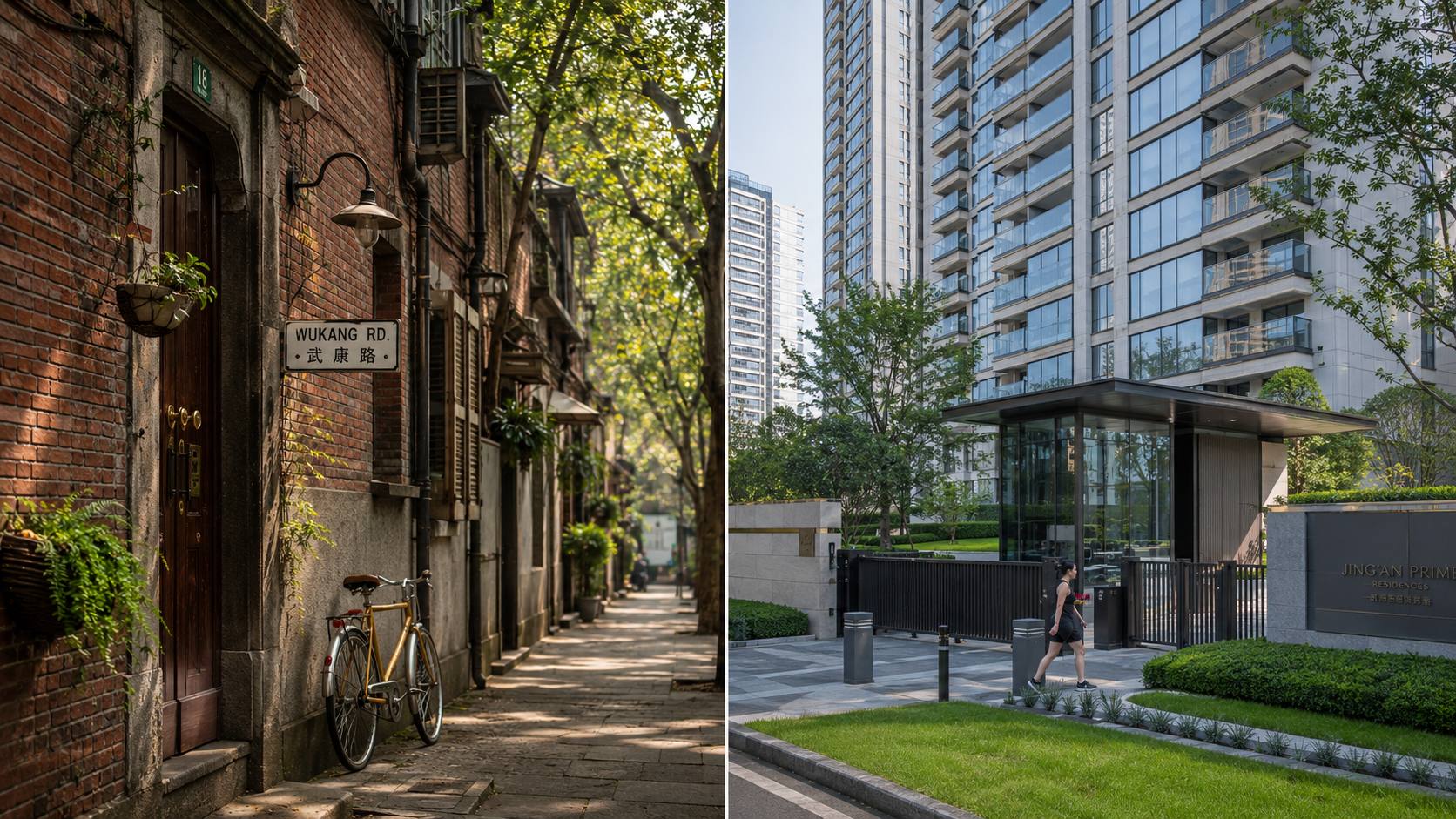
What we mean by each
Lane houses (弄堂房子, longtang housing) are Shanghai’s heritage low-rise stock — shikumen and townhouse-style homes built roughly between the 1910s and 1940s, arranged along lanes in the old core: Old Xuhui and the Former French Concession above all. Today’s rental versions range from single floors carved out of a house to fully renovated whole houses with gardens.
Modern compounds are the gated residential developments built from the 1990s onward — towers or mid-rises around landscaped grounds, with property management, security, elevators, and often gyms, pools and parking.
Round 1: Character and daily texture
No contest, and everyone knows it. A lane house gives you architecture with a biography — original staircases, deep window sills, ceilings a modern developer would never approve. Your morning starts with a walk down a lane where laundry hangs and neighbours’ lives happen at street level. It is the Shanghai people move across the world for.
Compound life is anonymous by comparison — pleasantly, deliberately so. The texture is convenience: the package room, the predictable lobby, the elevator ride.
If you feel nothing looking at lane house photos, take the compound and never look back. If you feel a pull — read on, because the next rounds are where the romance meets the radiator.
Round 2: Winter and summer
Here’s the honest part. Shanghai winters are damp, grey and genuinely cold indoors, and heritage buildings were not built for thermal comfort. A poorly renovated lane house in January is a character-building experience in the wrong sense: single glazing, draughts, wall-unit air conditioners fighting physics.
The catch: a well renovated lane house — double glazing, underfloor heating, insulation done during gut renovation — is warm, and those exist in growing numbers (at a rent premium that is absolutely worth paying). When viewing heritage stock, heating is question one, two and three. Our winter heating guide covers exactly what to check.
Compounds win this round on averages: newer construction, central or better AC systems, and premium buildings with proper heating throughout. In August the same logic runs in reverse — modern insulation and sealed windows cool efficiently; heritage charm leaks.
The rule: never rent a lane house you haven’t interrogated about winter.
Round 3: Maintenance and management
Old buildings need things. Pipes are older, wiring has history, roofs occasionally remember they’re ninety. What determines your experience isn’t whether something will need fixing — something will — but who fixes it and how fast. A lane house with a responsive landlord is fine; one with an absentee owner and no management company can turn a leak into a saga. This is, frankly, where renting heritage stock through people who know the buildings and the owners earns its keep — and why your contract’s repair clause matters (see our contract guide).
Compounds industrialise this problem away: property management on call, building systems maintained on schedule, a hotline instead of a hope. Round to the compounds, decisively.
Round 4: Space, light and layout
Lane houses offer things compounds structurally cannot: vertical living across floors, private outdoor space — a terrace, a small garden, a roof deck — and proportions from an era of generous ceilings. They also offer quirks: stairs (no elevator, ever), oddly shaped rooms, and kitchens/bathrooms retrofitted into spaces that predate both.
Compounds deliver rational floor plans, elevators, and usually better bathrooms per square metre. Families with strollers, anyone with mobility concerns, and dedicated home-cooks tend to be structurally happier in compounds — while couples who dream of morning coffee on a private terrace can only get that dream in a lane.
Round 5: Sound and neighbours
Lane life is intimate. You will hear your neighbours — heritage walls and floors transmit — and they will know you. For some tenants that’s the charm: the lane greets you, the auntie next door adopts you. For others it wears thin by month three.
Compounds trade intimacy for insulation — literal and social. Better sound separation (in good buildings), neighbours you’ll never meet, and community outsourced to the compound’s gym and playground.
Know yourself here. This round has no winner, only self-awareness.
Round 6: The money
Like-for-like on size and location, renovated lane houses generally price at or above equivalent compound apartments — heritage scarcity is real, and the FFC has a monopoly on it. Unrenovated or partially renovated lane spaces can undercut compounds significantly, which is exactly when the winter question becomes decisive.
Utilities tilt compound too: heating and cooling leaky heritage volume costs more per month, and compounds’ management fees (usually landlord-paid) buy services lane houses simply don’t have.
So who should choose what?
Choose the lane house if: the architecture genuinely moves you; you’re a single, couple, or adventurous small family; you’ll pay the premium for a proper renovation (or accept winter honestly); you want the FFC street life as your living room; and you rent through someone who knows the building’s owner and history.
Choose the compound if: you want zero-friction living; you’re a family with young kids, or anyone for whom elevators and management matter; heating is non-negotiable; you cook seriously; or Shanghai is a 1–2 year chapter and you’d rather spend it living than maintaining.
The hybrid many people miss: garden apartments and older xincun-era or early-90s low-rise compounds in the FFC and Changning — some character, some management, moderate prices. And renovated apartments within heritage buildings run by professional landlords increasingly offer the look with the systems. The choice is a spectrum, not a binary — which is why compound guides and street-level knowledge beat listing photos every time.
Our unromantic professional summary: the best lane houses beat the best compounds, and the average compound beats the average lane house. The whole game is knowing which lane houses are the best ones — and that, conveniently, is our favourite subject.
Torn between the two? Tell us your budget and how you actually live — we’ll show you both options honestly, including the winter truth. Browse lane houses and compound listings in Old Xuhui, Jing’an and Changning, or message us on WeChat.

Join The Discussion