

If you are moving to Shanghai with a family, you will quickly discover a pattern. Parents talk. They compare compounds. They ask about schools, green space, and whether you can actually get a proper grocery delivery without waiting two hours.
And sooner or later, someone will say: Have you looked at Gubei?
Gubei and the broader Hongqiao area are not the flashiest parts of Shanghai. They do not have the cafe-dense streets of Anfu Road or the skyline views of Lujiazui. But they have something that matters more to many families: space, convenience, and a genuinely established international community.
Here is what you need to know about living in Gubei and Hongqiao — and why it is worth considering even if your office is in Jing’an or the FFC .
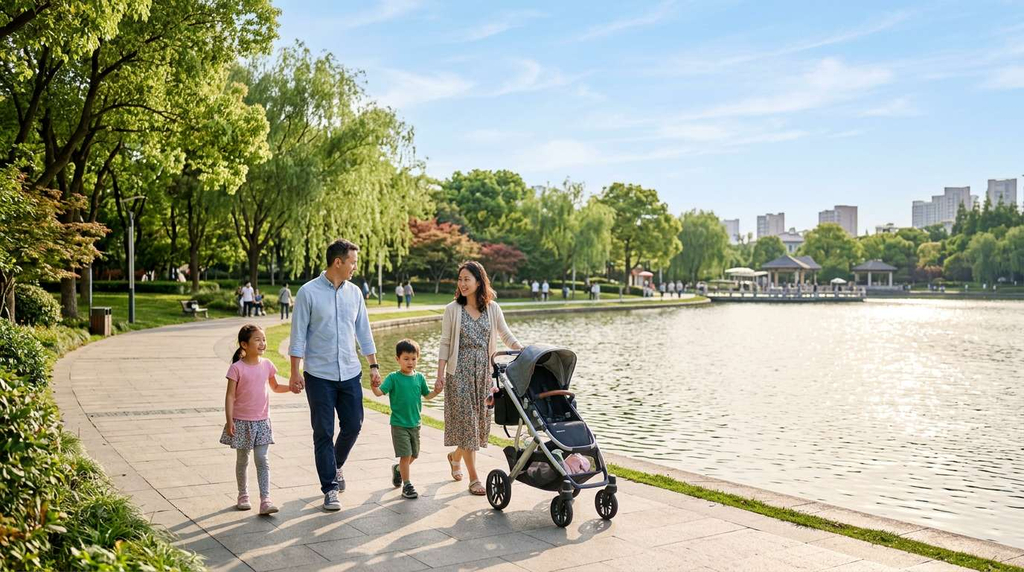
Where Exactly Are Gubei and Hongqiao?
Gubei is a sub-district within Changning District. It sits west of the Inner Ring Road and is bordered by Wuzhong Road to the south and Tianshan Road to the north . The area is well-served by Metro Lines 10 and 15, which connect directly to Hongqiao Airport and the city center .
Hongqiao is the broader region that includes Gubei as well as parts of Minhang District. It is defined by the Hongqiao transportation hub — the airport, the high-speed rail station, and the bus terminal. For anyone who travels regularly within China, this is a significant advantage .
Together, these areas form a sprawling, relatively low-density part of Shanghai that has been home to expat families for decades. It is not a single neighborhood. It is a collection of compounds, parks, international schools, and shopping centers, all connected by tree-lined streets .
Why Families Choose Gubei and Hongqiao
1. Space — Both Inside and Outside
Apartments in Gubei and Hongqiao tend to be larger than their equivalents in Jing’an or the Former French Concession. A three-bedroom apartment in the FFC might be 130–150 square meters. The same price in Gubei can get you 160–180 square meters or more .
For families who actually need rooms — separate bedrooms for children, a home office, a guest room — this extra space matters.
There are also more villas and ground-floor units with private gardens in this area compared to central Puxi . Compounds like Green Valley Villas and Gubei Central Garden (古北中央花园) offer the kind of outdoor space that is almost impossible to find in the FFC .
A 5-bedroom villa in Hongqiao Yijing Garden, for example, rents for around 38,000 RMB/month — a price that would get you a 3-bedroom apartment in a luxury compound in Jing’an .
2. A Genuinely International Community
Gubei has been a hub for expat families for decades. It was originally developed as housing for Japanese and Korean expats, and the infrastructure reflects that: Japanese supermarkets, Korean barbecue streets, and bilingual signage are everywhere .
Today, the area is home to residents from over 50 countries and regions — enough that it has earned the nickname “a little United Nations” . This means you are not just moving to a neighborhood with a few other expats. You are moving to a community that has been serving international families for 20+ years .
3. Schools — Lots of Them
This is the main reason families choose Gubei and Hongqiao. The area has one of the highest concentrations of international and bilingual schools in Shanghai .
The presence of these schools is not just about education. It is about the entire ecosystem that comes with them: school bus routes, families with similar schedules, and a community of parents who understand the challenges of raising children abroad .
4. Parks and Green Space
Gubei and Hongqiao have some of the best parks in Shanghai — and they are not the overcrowded weekend attractions that Fuxing Park sometimes becomes.
New Hongqiao Central Garden (新虹桥中心花园) is the standout. It covers 130,000 square meters, with a 10,000-square-meter central lake, large lawns, bamboo groves, streams, and shaded walking paths . The park opened in 2000 and has matured into a genuinely pleasant green space . It is open 24 hours, which is useful for families with early risers or evening strollers .
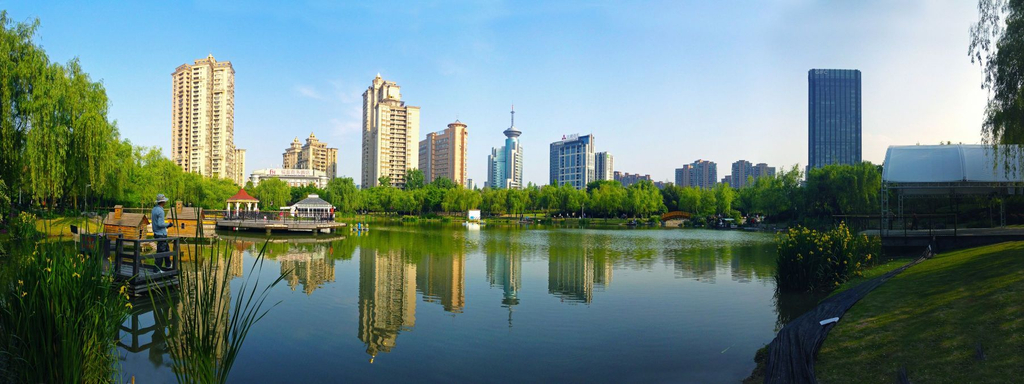
Changfeng Park is also nearby. It is larger and has more structured facilities, including a water park and an aquarium.
For families with young children, these parks are a daily resource rather than a weekend destination. You can push a stroller, let a toddler run on the grass, and stop for coffee at Kaveh Kanes, the café inside New Hongqiao Central Garden .
5. Daily Convenience
Gubei was built for families, and the infrastructure shows it.
There are multiple international supermarkets, including City Shop and Ole, which stock Western groceries . There are Japanese and Korean supermarkets that offer products you simply cannot find in other parts of Shanghai . There are international clinics — United Family Hospital has a clinic in Gubei, and the main Hongqiao campus is close by .
The Gubei Civic Center is another practical resource. It is a community hub that offers administrative services, cultural activities, and a “Five-in-One” service station covering visa, tax, and immigration support for expats . This is the kind of institutional infrastructure that families need — and it is already in place .
The Hongqiao Talent Hub (虹桥人才荟) also operates out of the Gubei Civic Center, providing a “one-stop” service for overseas talent, including work permits and residence permits. The center includes a bilingual tax service station and a “One-Stop Government Service” (一网通办) self-service terminal, allowing residents to handle over 1,200 administrative tasks on-site .
The Trade-Offs: What You Give Up
Gubei and Hongqiao are not for everyone. The trade-offs are real.
Distance from the City Center
If you work in Lujiazui, Jing’an, or the FFC, your commute will be longer than if you lived in those neighborhoods. The metro lines cover the area well, but you are still 20–40 minutes from the center of the city . For some families, this is a worthwhile trade-off. For others, it is a deal-breaker.
Less “Charm”
Gubei is not picturesque in the way the Former French Conception is. The streets are wider. The buildings are newer. The architecture is functional rather than romantic. There are no 1920s lane houses with wrought-iron balconies. There is no Wukang Building. If you want old Shanghai charm, this is not the area .
Car Dependency
While you can get around Gubei by metro, many families choose to buy a car. The area is spread out. Schools, parks, and supermarkets are not always within walking distance. If you prefer a walkable lifestyle, the FFC or Jing’an will suit you better.
Rentals: What to Expect
Gubei offers better value for larger apartments and villas than central Puxi .
Recent listings show a 3-bedroom apartment in Gubei Central Garden at ¥38,000/month for 160 sqm, and a 2-bedroom in Gubei International Plaza at ¥26,800/month for 130 sqm . A 5-bedroom villa in Hongqiao Yijing Garden at ¥38,000/month for 200 sqm offers more space for a comparable price .
The Bottom Line
Gubei and Hongqiao are not the most exciting neighborhoods in Shanghai. They are not where you go for a night out or a trendy brunch. They are where you go to raise a family — to find space, schools, parks, and a community that has been serving international families for decades.
If that is what you are looking for, Gubei is worth a serious look.
Looking for a family home in Gubei or Hongqiao? We can help you find it — and we know the schools, the parks, and the compounds that actually work for families.
Shanghai Rentals
WeChat: 13816427716
Email: info@shanghai-rentals.com

Join The Discussion