

You’ve landed in Shanghai, picked up your keys, and collapsed onto your new sofa. Congratulations — but before you unpack a single box, there’s one piece of paperwork the law expects from you within 24 hours: temporary residence registration (临时住宿登记, línshí zhùsù dēngjì).
It sounds more intimidating than it is. The good news: in Shanghai, you can now do the whole thing online in about ten minutes — no trip to the police station required [unlike the photo below😉]. Here’s exactly how it works in 2026, when you need to redo it, and what happens if you forget.
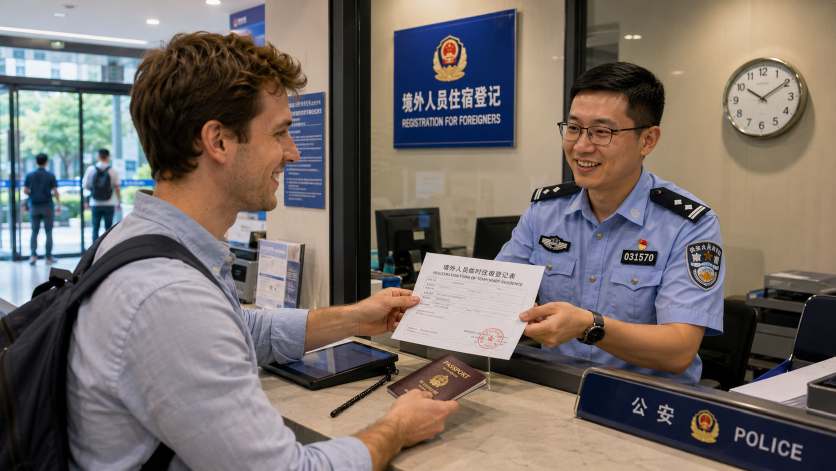
What is police registration, and why does it exist?
Under China’s Exit-Entry Administration Law, every foreign national staying in China must register their address with the local police within 24 hours of arrival. Think of it as the foreigner’s version of hukou — the household registration system that applies to Chinese citizens.
If you stay in a hotel, this happens invisibly: the front desk scans your passport at check-in and reports your stay automatically. You don’t need to do anything.
But the moment you stay anywhere that isn’t a licensed hotel — your own rented apartment, a friend’s spare room, an Airbnb — the responsibility shifts to you.
Why you should actually care
The registration form you receive (officially the Registration Form of Temporary Residence) is a small document with an outsized role in expat life. You’ll be asked for it when you:
- Extend or renew a visa or residence permit — the Exit-Entry Bureau will want to see it
- Apply for a work permit or change employers
- Convert a foreign driving licence to a Chinese one
- Open some bank accounts or handle other official paperwork
- Apply for a police clearance certificate later (for immigration to another country, for example)
Skipping registration rarely causes trouble today — it causes trouble six months from now, when your visa renewal hits a wall because there’s no record of where you’ve been living.
The online process, step by step
Shanghai was the first city in China to move registration online, and the system — the Self-Help Declaration System for Overseas Personnel’s Accommodation Registration — is genuinely one of the more foreigner-friendly government websites you’ll encounter. It’s available in English and Chinese.
What you’ll need before you start:
- A photo of your passport ID page (clear, no glare)
- Your full address in Shanghai — ideally in Chinese characters, so copy it from your lease or ask your agent
- Your arrival date and intended departure date (your visa expiry is fine)
- A phone number or email for the confirmation
The steps:
- Go to the official portal at gaj.sh.gov.cn/crj/24hr (search “Shanghai 24hr self-help declaration” if the link changes) or use the WeChat mini-program version.
- Create an account — email or phone number, takes a minute.
- Choose “Accommodation Registration” and upload your passport photo page. The system reads your details automatically; check and correct anything it misread.
- Enter your Shanghai address, arrival date, and planned departure date. Depending on your case, you may be asked to upload a verification photo of yourself holding your passport.
- Submit. Approval usually comes back within minutes to a few hours.
- Log back in, open your registration history, and download the PDF of your registration form. Save it to your phone and keep a printed copy with your passport.
That’s it. No queue, no photocopies, no charades with a duty officer at 8am.
If the online review fails — it occasionally does when a passport photo is blurry or an address doesn’t match the police database — you’ll need to do it the old-fashioned way: visit your neighbourhood police station (派出所, pàichūsuǒ) with your passport and lease. Your landlord or agent can usually tell you which station covers your compound, and for first-time registrations some stations still prefer to see you in person anyway.
When do you have to register again?
This is the part most people get wrong. Registration isn’t a one-time task — it resets in several situations:
- You move to a new address. New apartment = new registration, even if you just moved across the street. This is the one that catches renters.
- You get a new passport. New passport number = new registration.
- You re-enter China (for visitors without a residence permit). If you’re on a tourist or business visa, each re-entry technically requires re-registration. Residence permit holders staying at the same registered address generally don’t need to re-register after short trips abroad — but rules are applied with varying strictness, and re-registering online takes five minutes, so when in doubt, just do it.
What happens if you don’t register?
Penalties range from a warning for a first offence to a fine of up to ¥2,000. In practice, first-timers who show up late and apologetic usually get a warning — but the fine is real, and repeat offences can complicate future visa applications, which is the far more expensive problem.
The pattern we see most often: someone registers diligently when they first arrive, then moves apartments a year later and forgets that moving means re-registering. Don’t be that person — it’s a ten-minute job the day you get your keys.
A note for our tenants
If you rent through us, consider this handled: we walk every tenant through the online registration as part of move-in, and where a police station visit is needed, we’ll tell you exactly which station covers your compound and what to bring. It’s a small thing, but it’s the difference between a smooth visa renewal and a very stressful week at the Exit-Entry Bureau.
Quick FAQ
I’m staying in a hotel for my first two weeks. Do I need to register? No — the hotel does it automatically. But the day you move into your apartment, the clock starts again: register within 24 hours of moving in.
Does my landlord register for me? Legally the obligation can fall on either side, and some landlords or agents will handle it — but never assume. You’re the one whose visa renewal depends on it. Ask, and if in doubt, do it yourself online.
I registered when I arrived, then went to Thailand for a weekend. Do I need to re-register? If you hold a residence permit and returned to the same address, generally no. On a tourist or business visa, technically yes after every entry. Online it takes minutes, so re-registering is the safe default.
Is there a fee? No. Registration is free, whether online or at the station.
I lost my registration form. What now? Log back into the online system and re-download the PDF. If you registered in person, return to the same police station and ask them to reissue it.
I never registered and I’ve been here for months. Am I in trouble? Register now rather than waiting for a visa renewal to expose the gap. Go in person, be polite and honest — a warning is the most common outcome for a first lapse, and having the registration sorted matters more than the awkward conversation.
Rules and systems change — this guide reflects the process as of 2026, but always check the official Shanghai Exit-Entry Administration channels or ask us if you’re unsure. Looking for a home in the Former French Concession, Jing’an, or Changning? Browse our listings or reach us on WeChat — and yes, we’ll sort your registration with you.

Join The Discussion