

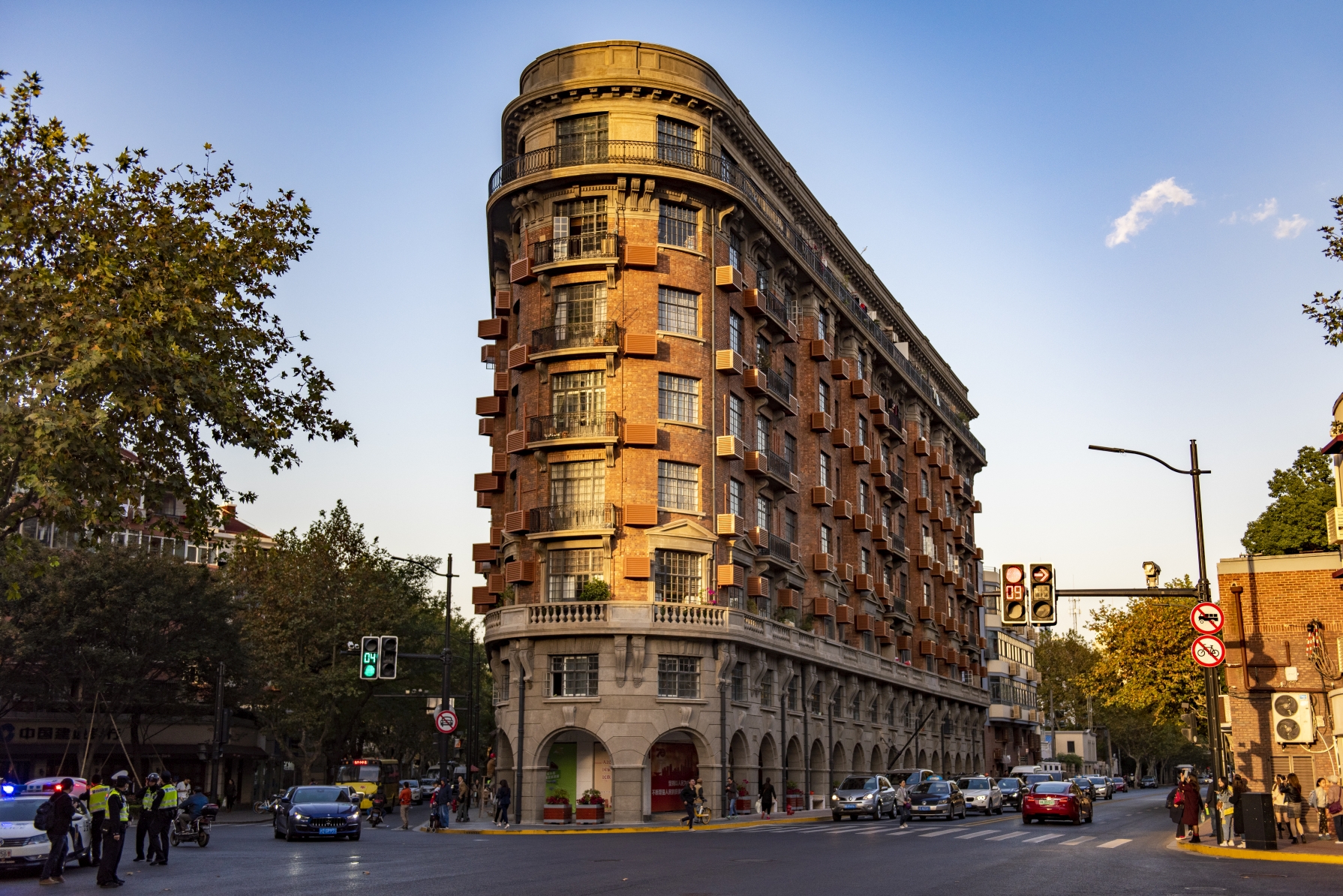
Stand at the junction of Wukang Road and Huaihai Middle Road on any weekend and you’ll see them: hundreds of people, phones raised, photographing the same building. The Wukang Building (武康大楼) — that magnificent flatiron-shaped prow of brick and concrete — has become Shanghai’s most photographed address, the face of the entire Former French Concession.
Our office sits a few minutes up Wukang Road, which means we walk past it daily, field questions about it weekly, and can answer the one question the tourists never think to ask: what is it actually like to live there — and could you?
A ship launched in 1924
The building began life as the Normandie Apartments, designed by László Hudec — the Hungarian-Slovak architect who escaped a Siberian POW camp, landed in Shanghai, and proceeded to define the city’s skyline (the Park Hotel and Grand Cinema are also his). Completed in 1924 and financed through the International Savings Society, it was Shanghai’s earliest veranda-style apartment building: eight storeys, French Renaissance style, 30 metres tall, with 63 apartments, 30 servants’ quarters and three elevators.
The wedge shape wasn’t a flourish — Hudec was fitting a triangular plot where Route Ferguson met Avenue Joffre. The result resembles an ocean liner cutting through the Concession, and the comparison everyone reaches for — New York’s Flatiron Building — is fair, except the Wukang came with wraparound verandas and a top-floor corridor circling the entire building for the view.
Ninety years of remarkable tenants
The first residents were Western executives of Concession-era companies. In 1942 the building was bought by Kung Ling-wei, daughter of the banker H.H. Kung — and in the golden age of Shanghai cinema it filled with film royalty: Zhao Dan, Qin Yi, Wang Renmei, Shangguan Yunzhu, and the actor-director Sun Daolin, who lived here for thirty years. Soong Ching-ling, widow of Sun Yat-sen, lived directly across Huaihai Road (her residence is now a museum — visit it).
The building’s history carries darkness too: during the Cultural Revolution it acquired the grim local nickname “The Diving Board,” and the actress Shangguan Yunzhu was among those who died here. Renamed Wukang Mansion in 1953, it passed into city ownership, housing officials, intellectuals and artists — many of whose families remain today, some now third-generation residents who see themselves as custodians of the building.
The renovation and the fame
Xuhui District restored the building in 2008 and gave it a major facelift more recently — critically, the city also removed the utility poles and overhead cables that had cluttered every photograph for decades. Clean sightlines plus social media did the rest: the Wukang Building went viral, and the junction now has pedestrian marshals on busy days. The ground-floor arcade turned cultural too — bookshops, a gallery, and some of the neighbourhood’s most photographed café seating now line the veranda where a roast-duck stall and a pharmacy once served residents.
So — can you actually live there?
Here’s the honest answer the Instagram posts won’t give you. The Wukang Building is a municipally protected historic building still largely under public housing management — most residents are long-term tenants of the district housing authority, many elderly, some in apartments their families have held since the 1950s. Units essentially never appear on the open rental market, and the rare private-rights apartments that exist change hands quietly and infrequently. It is, first and foremost, a living community — one that has been vocal about tourist crowds peering into their lobby.
So no, we can’t rent you an apartment in the Wukang Building (you can still ask us anytime if there is any changes with this statement though!) — and we’d be suspicious of anyone who claims they can.
But here’s what we can do. The magic of the Wukang Building isn’t only the building — it’s the neighbourhood pattern it anchors: heritage apartments with verandas and proportions from the same golden decade, on the same streets, several of which do reach the rental market. Within a ten-minute walk you’ll find 1920s–40s apartment buildings and lane houses on Wukang Road, Hunan Road, Xingguo Road and Huaihai itself with the same bones — high ceilings, original details, plane-tree views — minus the tour groups at your door. That corner of Old Xuhui (the Hengshan-Fuxing Historic Protection Zone, to give it its official name) is precisely our home turf.
Visiting well
If you’re coming to photograph it: early morning gets you the light and spares you the crowd; the classic angle is from the Soong Ching-ling residence side; and Xuhui District runs heritage walking tours from 393 Wukang Road (Huang Xing’s former residence) that cover the street’s 37 protected buildings — worth booking if the architecture hooks you. Then walk north up Wukang Road past the cafés and villas, and you’ll understand within five minutes why people don’t just photograph this neighbourhood — they move here.
Which, conveniently, is where we come in.
Fallen for the Wukang Building? The same streets hold heritage apartments and lane houses you actually can rent — and our office is on Wukang Road itself. Browse our Old Xuhui listings or drop in; we’re neighbours.

Join The Discussion